Kashvi

EDITORIAL RESEARCH PROJECT, JAN 2026
Systems of living
Context
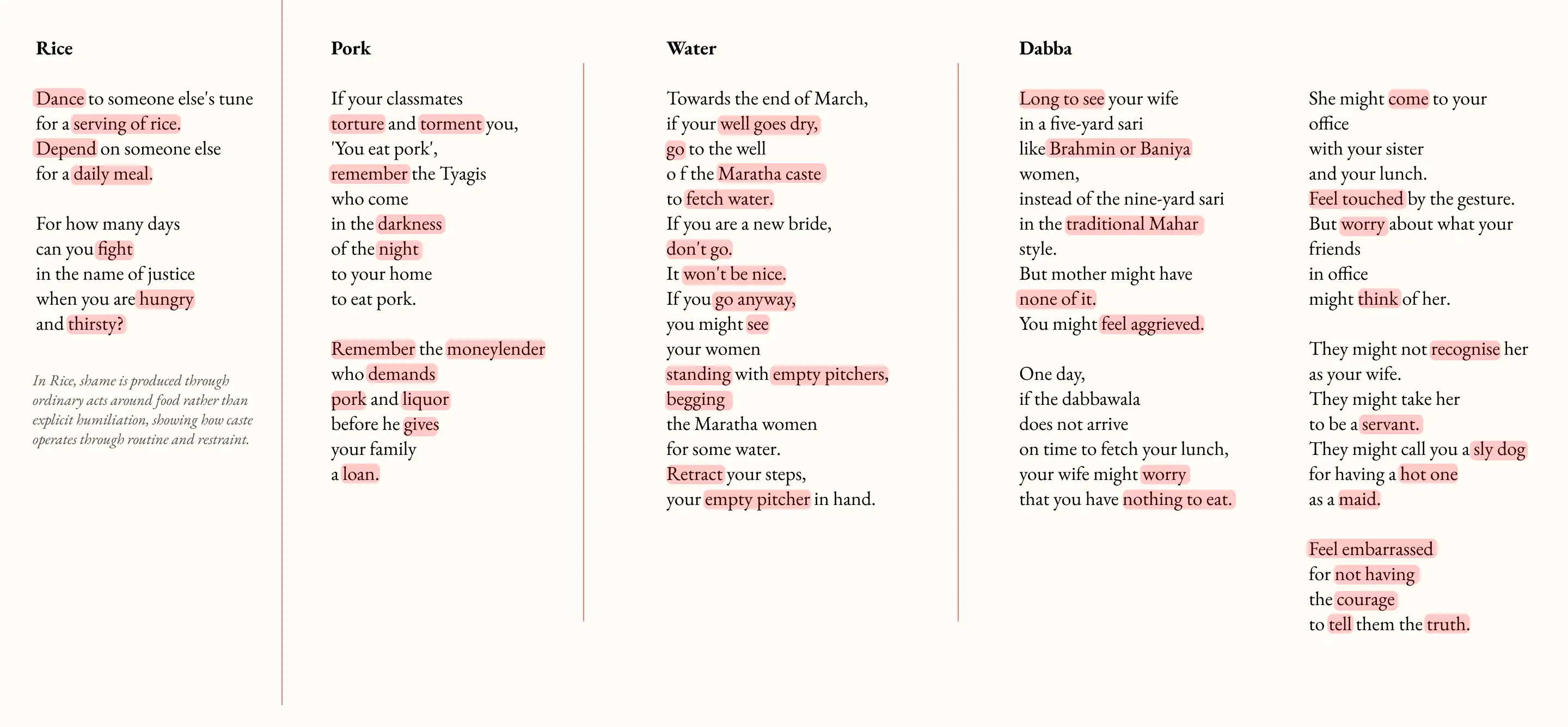
This project emerged from a reading and annotation workshop (Rajyashri Goody’s Don’t Lick It All Up) that examined a set of poems describing everyday acts of eating, labour, schooling, worship, and survival. The poems are drawn from Dalit writing in translation.

Dalit people have been treated as untouchable and impure for thousands of years, and many are still denied basic rights to land, food, water, and literacy in India. The initial question was simple: what happens if these poems are read not as individual testimonies, but as systems of repeated commands?

Rather than analyzing imagery or emotion, the workshop focused on tracking instructions and routines communicated through the text. The poems were treated as evidence of social inequity, where violence is normalized through repetition rather than spectacle.

This project builds on top of that exercise. Examination of sixteen of those poems is presented together, followed by a thematic reading that traces how the same structures recur across different contexts. The aim is not interpretation, but visibility. The aim is to improve the visibility.
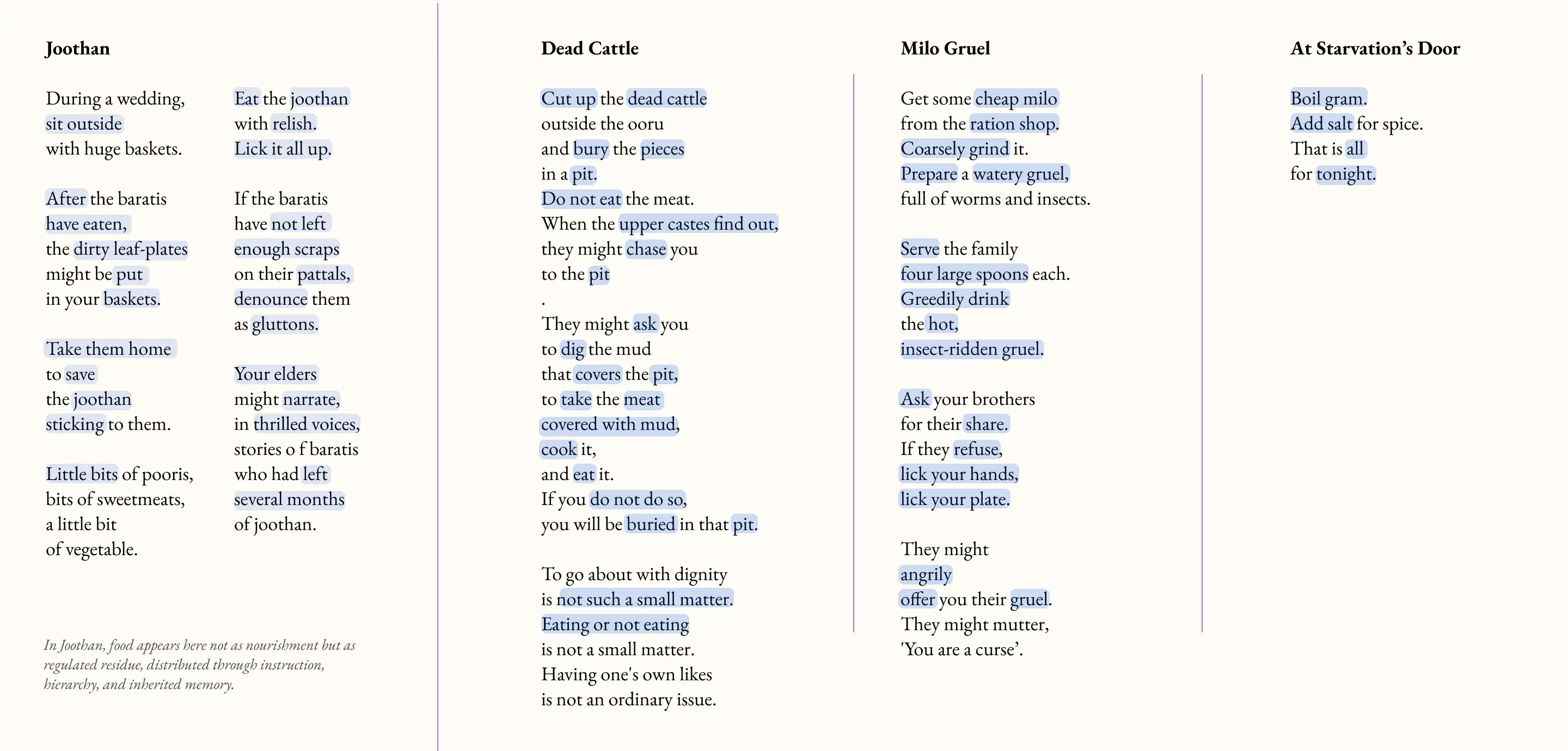
Food is regulated more than it is consumed
In the above poems, food is depicted as a means of control. It is used as a weapon to control distribution and deny access to things.

Food functions as a site of control, distribution, and denial, with the act of eating itself often neglected or implied.

Across all of them food appears not as a source of nourishment rather as a tool of establishing dependence. Access to it is conditional, delayed, monitored, or humiliating, all to establish a sense of control. Eating becomes a mode of obedience, silence, and gratitude. Hunger shortents the horizon of resistance, making justice a deferred luxury.
Shame is enacted, not named
Shame is not spoken about directly. It is communicated through actions, rules, and the way a space is controlled.

These poems move through places where dignity is slowly taken apart. Waste, leftovers, and punishment shape daily life and set the terms for how people live and move.

Humiliation is not accidental but purposeful. It becomes a lesson that is repeated again and again. In this way, shame is taught, practiced, and passed down as an ordinary part of everyday life.
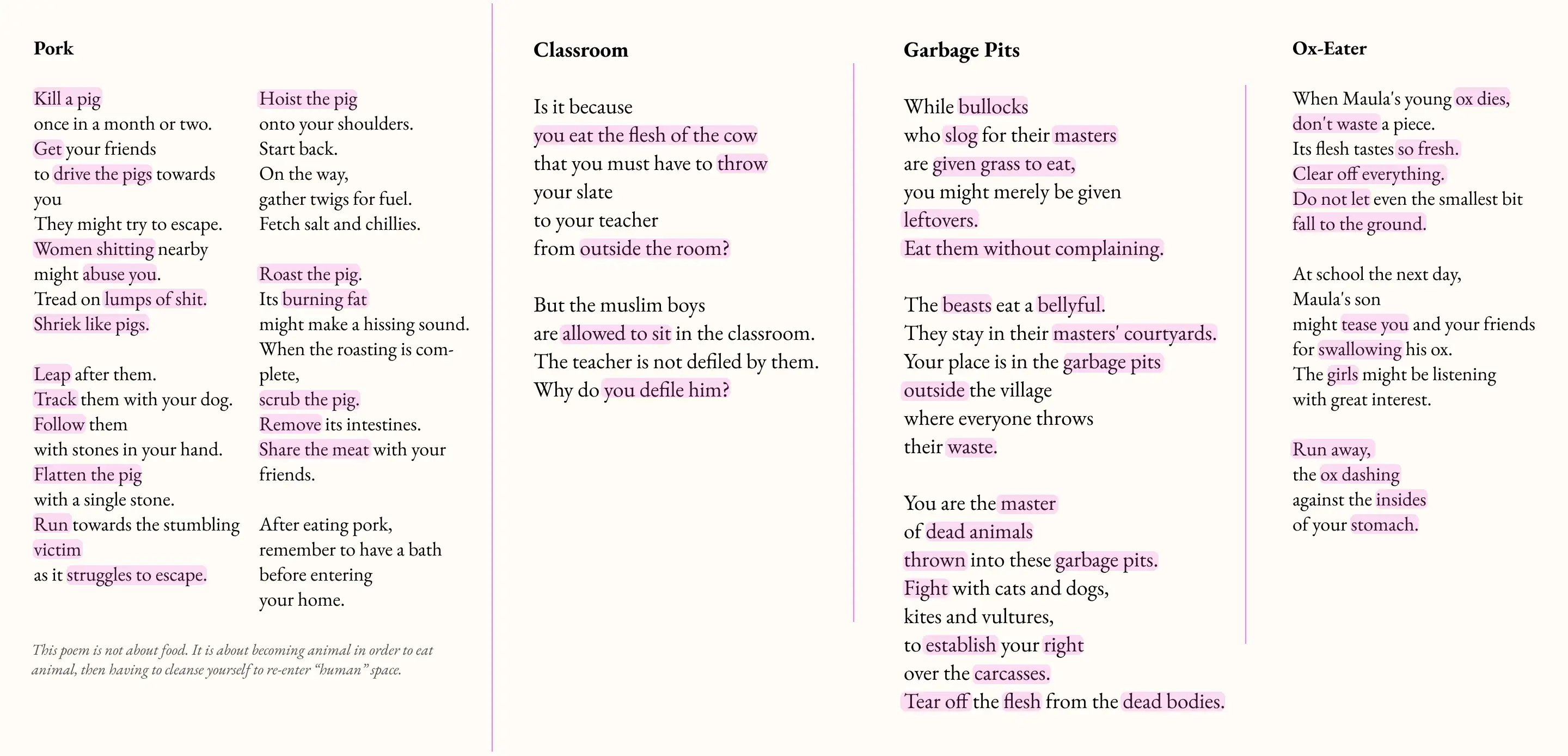
Animals only appear at points of dehumanisation, not universally
Animals only appear at moments of dehumanisation rather and not in the rest of the poem. They appear during scenes of violence or control, and disappear elsewhere.

Across these poems, the line between human and animal begins to blur through hunger, work, and accusation. Animals show up as food, as insults, as burdens, and as evidence used against the body. Eating becomes both a way to survive and a source of shame. Using this, the body is controlled, and it judged through what it consumes and what it is said to resemble.
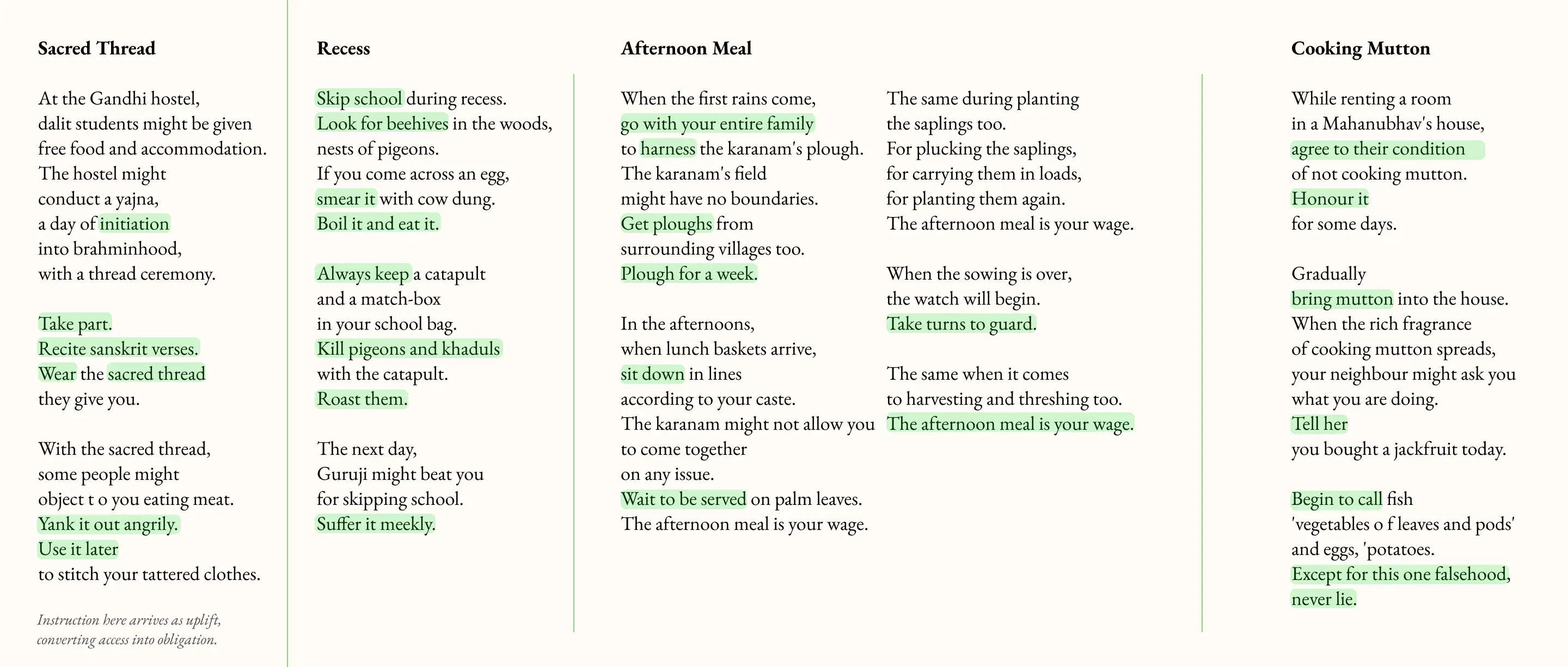
Instruction replaces force as a dominant mode of power
Instruction takes the place of force as the main way power operates. Commands, warnings, and rules carry authority even without open violence, shaping how food is handled and how bodies move.

In these poems, control is direct and procedural. Initiation, labour, hunger, and secrecy are all managed through clear directions. Participation is permitted, but only on terms that can be revoked at any moment. What looks like inclusion often turns out to be obligation, and access gradually becomes a form of surveillance.
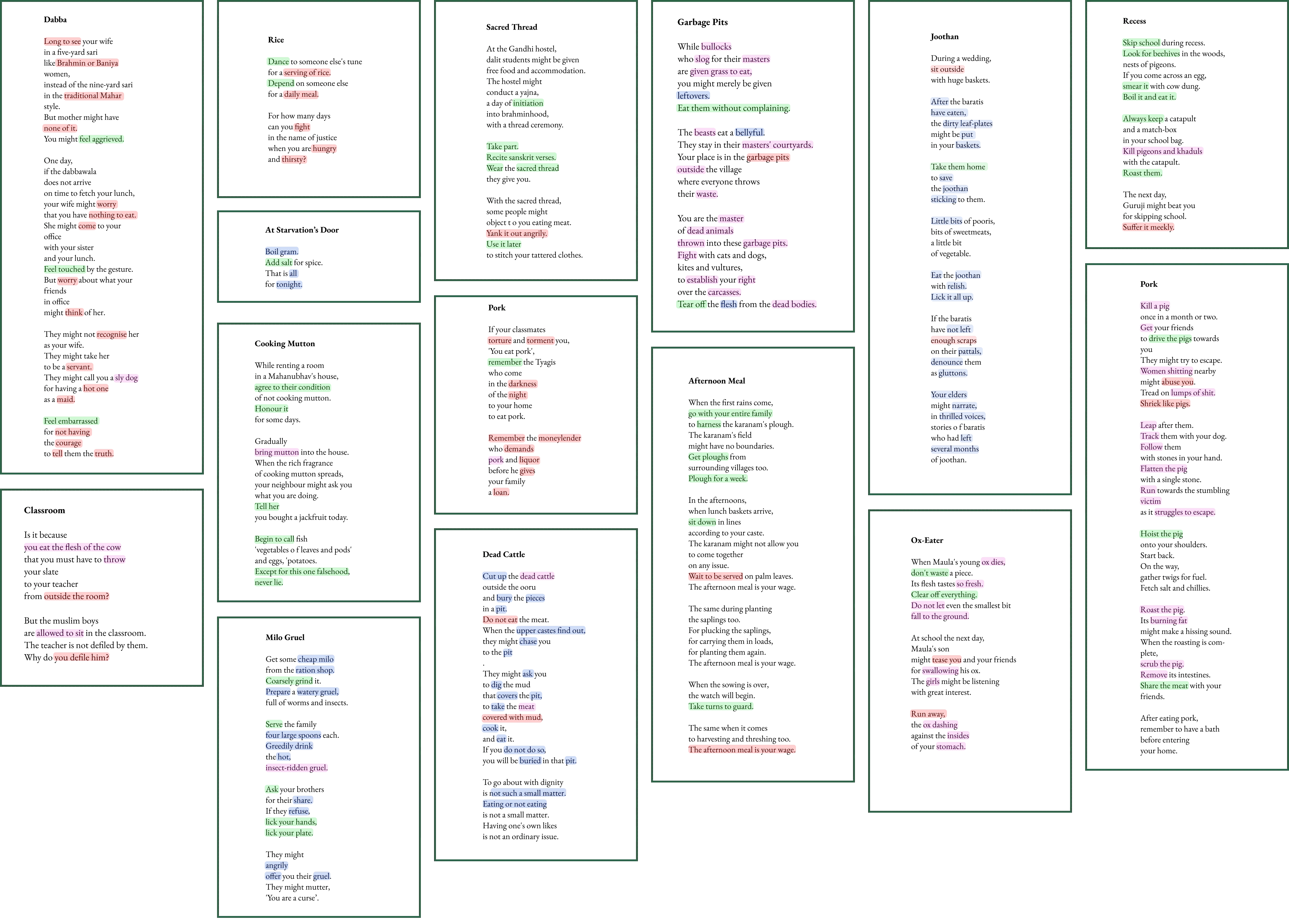
Intersection
Across themes, the same instructions recur: eat this, wait here, lie quietly, endure, be grateful.

When food becomes labour, labour becomes punishment, and punishment becomes routine, the themes no longer remain separate. Overlap is not coincidence. It is structure.

Here are a few examples,
Method Note
These poems were selected for their use of direct instruction and repeated actions. Rather than focusing on imagery or tone, we paid attention to verbs, commands, permissions, and prohibitions, tracing how language directs behaviour.

Where themes overlapped, those connections were deliberately preserved to reveal patterns that echo across the work. This approach highlights structural repetition instead of forcing the poems into neat or separate categories.
Closing Notes
A close reading draws attention to personal pain and experience. A structural reading takes a few steps back and looks at the larger picture, showing how these experiences are shaped by something beyond any one life.

By placing the poems side by side, the project shows how repetition makes violence feel normal, how instructions quietly take the place of force, and how even survival is carefully controlled. What becomes apparent is that this is not just a set of separate stories, but a system that teaches people how they are expected to live in it.
Portfolio 2026